036Noble gas · Group 18 · Period 4
Krypton
Krypton (Kr) is element 36, a noble gas in the p-block — group 18, period 4. It is a gas at room temperature with 4 electron shells (2, 8, 18, 8) and an atomic mass of 83.7982 u.
- Atomic mass
- 83.80 u
- Phase · STP
- gas
- Melting
- 116 K · -157 °C
- Boiling
- 120 K · -153 °C
- Electronegativity
- 3
- Density
- 3.749 g/cm³
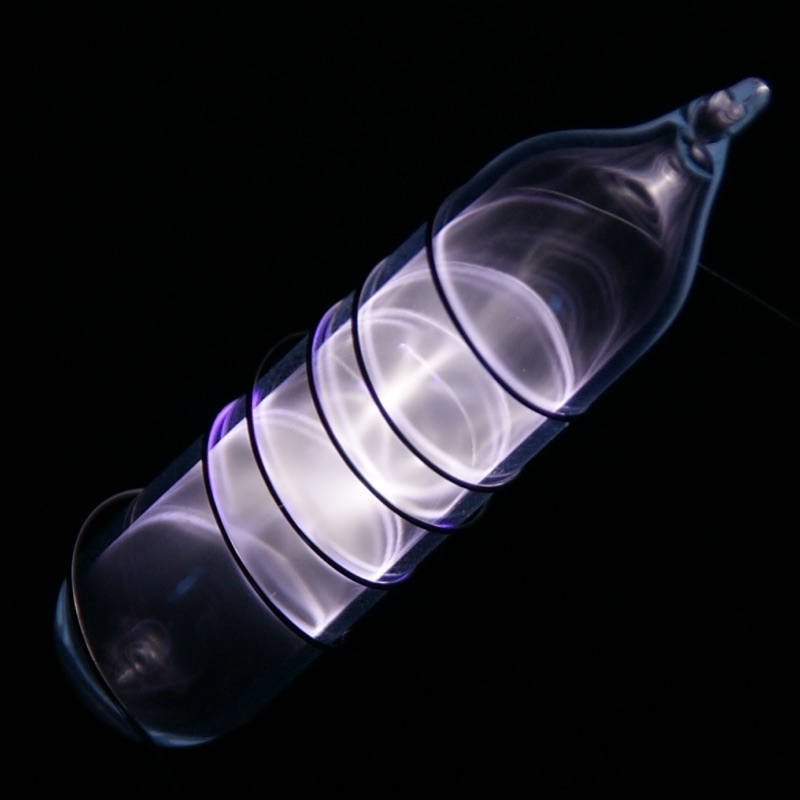
Photograph — Jurii, CC BY 3.0 <https://creativecommons.org/licenses/by/3.0>, via Wikimedia Commons, source: https://images-of-elements.com/krypton.php
Emission spectrum
The visible light Krypton emits when energised — its unique spectral fingerprint.

Identity
- Atomic number
- 36
- Standard atomic weight
- 83.80 u
- Category
- Noble gas
- Group
- 18 · Noble gases
- Period
- 4
- Block
- p-block
- Oxidation states
- 0
Physical properties
- Melting point
- 116 K · -157 °C
- Boiling point
- 120 K · -153 °C
- Density
- 3.749 g/cm³
- Molar heat capacity
- —
- Atomic radius
- 202 pm
- Electron affinity
- -96 kJ/mol
Atomic structure
36protons
48neutrons
36electrons
8valence e⁻
- Noble-gas notation
- [Ar] 3d10 4s2 4p6
- Full configuration
- 1s2 2s2 2p6 3s2 3p6 4s2 3d10 4p6
- Electrons per shell
- 2, 8, 18, 8
Periodic trends
Where Krypton ranks across all 118 elements.
Ionization energies
Energy to remove each successive electron (kJ/mol).
1.4k1
2.4k2
3.6k3
5.1k4
6.2k5
7.6k6
10.7k7
12.1k8
22.3k9
25.9k10
Successive ionization energies (kJ/mol, log scale).
Discovery
- Discovered
- 1898
- Discovered by
- William Ramsay
- Named by
- —
- Appearance
- colorless gas, exhibiting a whitish glow in a high electric field